The Engine Behind DE Copilot: Why the Canonical Metadata Model Matters
Most people see DE Copilot as a code generation tool. The real engine sits in the middle - a metadata abstraction layer that transforms enterprise STTMs into unlimited engineering deliverables.
When most people see DE Copilot, they see a simple workflow:
Upload STTM
      ↓
Generate SQL
      ↓
Download Artifacts
At first glance, it looks like another code generation tool.
But the real engine of the platform sits in the middle.
The Problem with Traditional STTM Processing
In most enterprise projects, the same STTM is interpreted multiple times by different teams.
A data engineer reads it to build ETL pipelines.
A tester reads it to create test cases.
A data architect reads it to create design documents.
A governance team reads it to define data quality controls.
A documentation team reads it to build technical specifications.
The result is duplication, inconsistency, and a significant amount of manual effort.
STTM
  ↓
Engineer    → SQL
Tester      → Test Cases
Architect   → Design Document
Analyst     → Data Dictionary
DQ Team     → Validation Rules
Everyone starts from the same metadata.
Everyone recreates the same understanding.
The Canonical Metadata Model
DE Copilot approaches the problem differently.
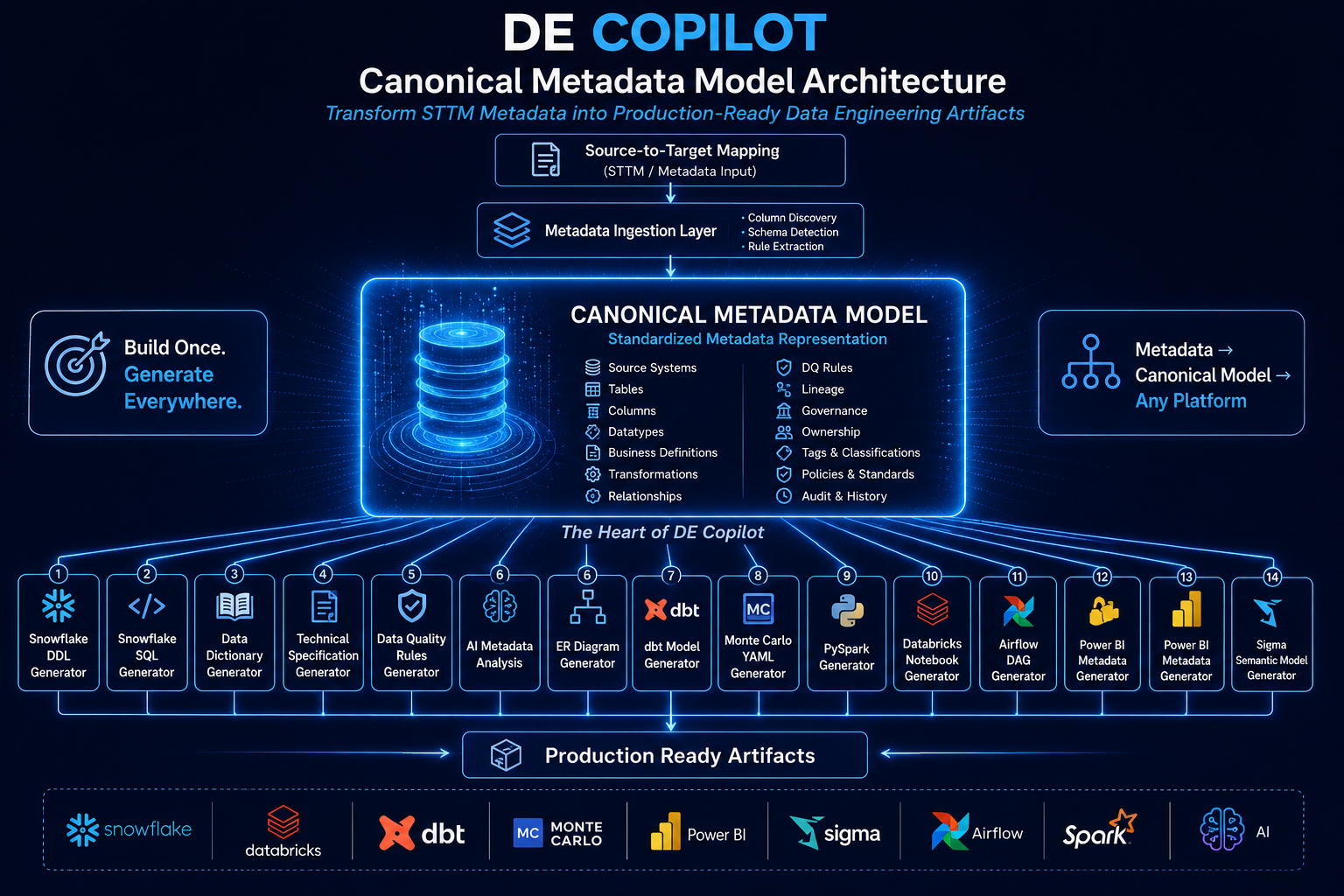
Instead of generating outputs directly from the uploaded STTM, the platform first converts the STTM into a standardized representation called the Canonical Metadata Model.
Enterprise STTM
        ↓
Canonical Metadata Model
        ↓
Artifact Generation Engine
This model acts as a universal metadata layer between enterprise mappings and downstream tools.
Regardless of how the original STTM is structured, the platform normalizes the information into a common format.
A simplified example:
{
  "source_table": "CUSTOMER",
  "source_column": "CUSTOMER_ID",
  "target_table": "DIM_CUSTOMER",
  "target_column": "CUSTOMER_KEY",
  "datatype": "NUMBER",
  "nullable": false,
  "transformation": "DIRECT_MAP"
}
Once metadata is represented in a standard structure, it can be reused repeatedly.
Why This Changes Everything
The key idea is simple:
An STTM should only need to be understood once.After the metadata is normalized, the same model can drive multiple outputs.
Canonical Metadata Model
        ↓
Snowflake SQL
PySpark
dbt Models
ADF Pipelines
Data Quality Rules
Test Cases
Documentation
Lineage
Impact Analysis
Instead of rebuilding logic for every technology platform, DE Copilot generates platform-specific artifacts from the same metadata foundation.
Example: One Metadata Model, Multiple Outputs
Imagine a mapping:
FIRST_NAME → CUSTOMER_NAME    → TRIM
LAST_NAME  → CUSTOMER_SURNAME → UPPER
The Canonical Metadata Model captures the intent once.
From there, different generators produce different outputs.
Snowflake SQLSELECT
TRIM(FIRST_NAME) AS CUSTOMER_NAME,
UPPER(LAST_NAME) AS CUSTOMER_SURNAME
FROM CUSTOMER;
df.select(
    trim(col("FIRST_NAME")).alias("CUSTOMER_NAME"),
    upper(col("LAST_NAME")).alias("CUSTOMER_SURNAME")
)
select
    trim(FIRST_NAME)  as CUSTOMER_NAME,
    upper(LAST_NAME)  as CUSTOMER_SURNAME
from {{ source('raw', 'customer') }}
The mapping never changes.
Only the generator changes.
How the Generators Work
A common question is: "Is AI generating all of this?"
Not necessarily.
The Canonical Metadata Model is the source of truth. Each target technology has its own generator.
Enterprise STTM
        ↓
Canonical Metadata Model
        ↓
────────────────────────────────
Snowflake Generator
PySpark Generator
dbt Generator
ADF Generator
DataStage Generator
Documentation Generator
Testing Generator
DQ Rules Generator
────────────────────────────────
Each generator understands how its target platform expects metadata.
- •A YAML-based observability platform expects YAML - the generator converts metadata into YAML.
- •dbt expects SQL and configuration files - the generator converts metadata into dbt assets.
- •ADF expects JSON - the generator converts metadata into pipeline definitions.
The same metadata powers all of them.
The Role of AI
AI becomes most valuable before and after the Canonical Metadata Model.
Before normalization:- •Column detection
- •Metadata classification
- •Business rule interpretation
- •PII detection
- •Entity recognition
- •DQ recommendations
- •Test case suggestions
- •Risk analysis
- •Impact analysis
- •Knowledge discovery
The Canonical Metadata Model remains the stable foundation.
AI makes the model smarter.
Beyond Code Generation
The long-term vision extends beyond SQL and ETL development.
The Canonical Metadata Model can become the foundation for:
- •Data Quality Rule Generation
- •Automated Test Case Creation
- •Technical Documentation
- •Lineage Discovery
- •Impact Analysis
- •Governance Controls
- •Knowledge Discovery
- •AI Metadata Assistants
In the future, the same metadata could power enterprise-wide engineering automation.
The Real Product
Many metadata tools focus on generating code.
The goal of DE Copilot is broader.
The goal is to create a metadata abstraction layer that sits between enterprise STTMs and implementation technologies.
Enterprise STTM
        ↓
Canonical Metadata Model
        ↓
Engineering Deliverables
The generated SQL is valuable.
The generated documentation is valuable.
The generated test cases are valuable.
But the real asset is the metadata engine that makes all of those outputs possible.
The generated artifacts may evolve. The target technologies may change. New tools will emerge.
But as long as the Canonical Metadata Model remains stable, new generators can be added without rebuilding the platform.
That engine is the heart of DE Copilot. That engine is the Canonical Metadata Model.
See the Architecture in Action
The Canonical Metadata Model provides the foundation for metadata-driven engineering automation.
To see the architecture applied against a real-world enterprise STTM, read:
➡️ Stress Testing DE Copilot with Enterprise STTM MetadataThis experiment demonstrates how a canonical metadata model can interpret enterprise mappings and generate engineering deliverables from a single STTM upload.
Ready to test it yourself?Upload a real STTM and see how DE Copilot generates engineering artifacts from a single metadata source.
➡️ Try DE CopilotContinue Reading
Why I Built DE Copilot
Data engineering teams spend countless hours on repetitive, metadata-driven work. The STTM already contains everything needed to build engineering deliverables. The challenge is that teams repeatedly translate that metadata into different formats.
Stress Testing DE Copilot with Enterprise STTM Metadata
Can a metadata-driven engine understand and generate engineering artifacts from large, complex STTM documents without custom coding for every project? Here is what happened when we put it to the test.