Stress Testing DE Copilot with Enterprise STTM Metadata
Can a metadata-driven engine understand and generate engineering artifacts from large, complex STTM documents without custom coding for every project? Here is what happened when we put it to the test.
The Question I Wanted to Answer
One of the questions I wanted to answer while building DE Copilot was:
Can a metadata-driven engine understand and generate engineering artifacts from large STTM documents without custom coding for every project?This is not a trivial question. Enterprise STTMs are not clean, uniform spreadsheets. They carry decades of organizational convention - inconsistent column naming, mixed transformation logic, governance metadata, DQ rules, SCD attributes, and masking controls all packed into a single document.
The objective of this test was not to benchmark runtime performance. The objective was to validate whether a metadata-driven architecture could understand, normalize, and generate engineering artifacts from a realistic enterprise STTM structure without project-specific customization.
What I Learned
The biggest realization was that STTM files are not data.
They are metadata describing data.The challenge is not processing millions of records. The challenge is understanding metadata structures that vary across organizations and transforming them into reusable engineering artifacts.
That realization significantly changed the design of DE Copilot.
The Test Dataset
To stress test the platform, I created a synthetic enterprise STTM containing:
- •100 mapping rows across multiple source systems
- •46 metadata attributes per row
- •Source system definitions
- •Source and target schemas
- •Data types and lengths
- •Transformation logic
- •Lookup definitions
- •Data quality rules
- •SCD attributes
- •Data masking rules
- •Ownership metadata
- •Governance controls
This is representative of what a mid-to-large enterprise data engineering team would produce for a single data product delivery.
Stress Test Summary
The Processing Pipeline
DE Copilot processes an STTM through a structured pipeline before generating any artifacts:
Upload STTM
      ↓
Metadata Detection
      ↓
Canonical Metadata Model
      ↓
Artifact Generation Engine
      ├─ Snowflake DDL
      ├─ Snowflake SQL
      ├─ Data Dictionary
      ├─ Technical Specification
      ├─ DQ Rules
      └─ AI Analysis
The key step is the Canonical Metadata Model - a normalized internal representation that abstracts away the inconsistencies in the source STTM. This is what allows the artifact generation engine to work consistently regardless of how the original mapping was structured.
DE Copilot STTM Factory
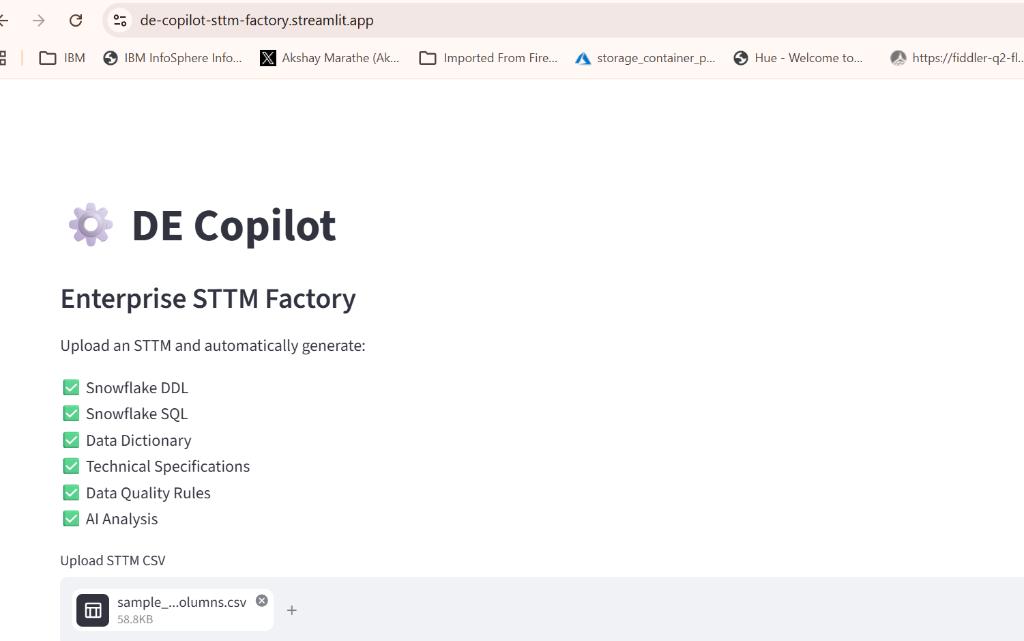
The DE Copilot STTM Factory lists every artifact it will generate: Snowflake DDL, Snowflake SQL, Data Dictionary, Technical Specifications, Data Quality Rules, and AI Analysis. The sample enterprise STTM CSV (58.8KB) is queued for upload.
STTM Upload Validation
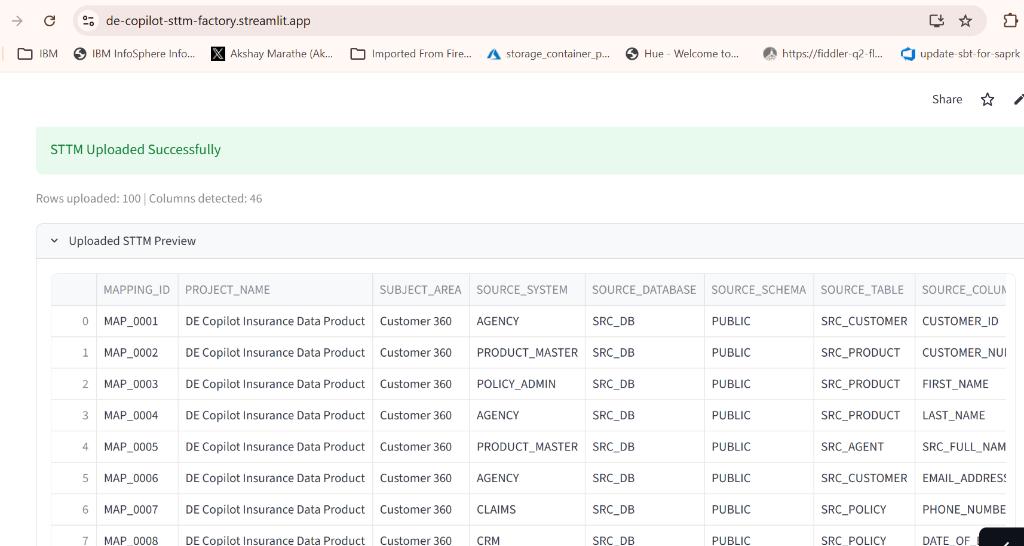
Upload confirmation: 100 rows uploaded, 46 columns detected. The preview table shows the first mapping rows across MAPPING_ID, PROJECT_NAME, SUBJECT_AREA, SOURCE_SYSTEM, SOURCE_DATABASE, SOURCE_SCHEMA, SOURCE_TABLE - all parsed automatically without any configuration.
Metadata Structure Detection
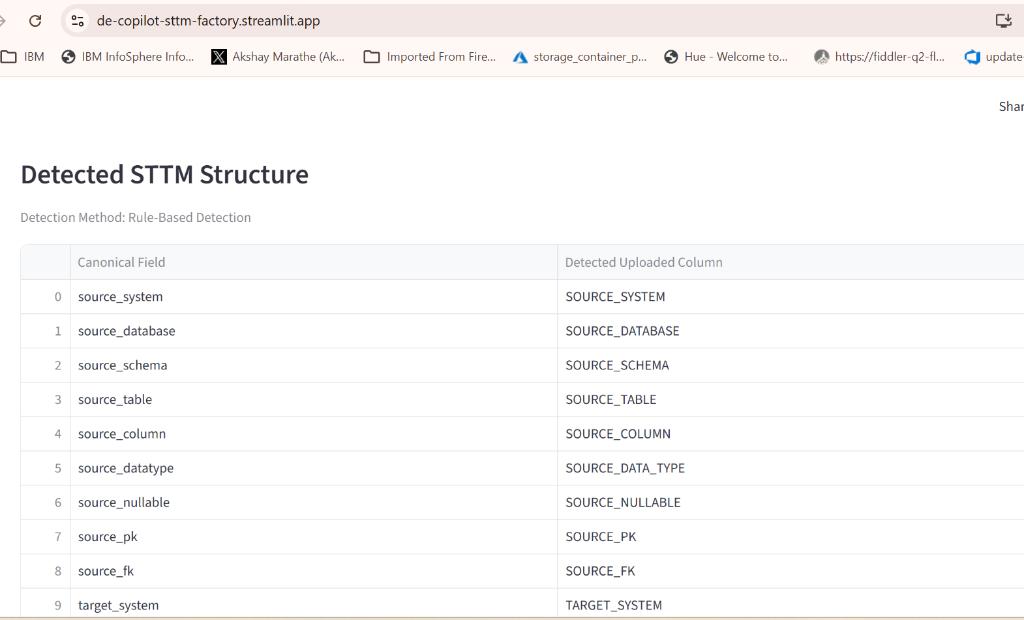
The structure detection phase maps uploaded column names to a canonical metadata model using rule-based detection. Fields like source_system, source_database, source_schema, source_table, source_column, source_datatype, source_nullable, source_pk, source_fk, and target_system are all identified and normalized automatically - no manual field mapping required.
Normalized Canonical Metadata Model
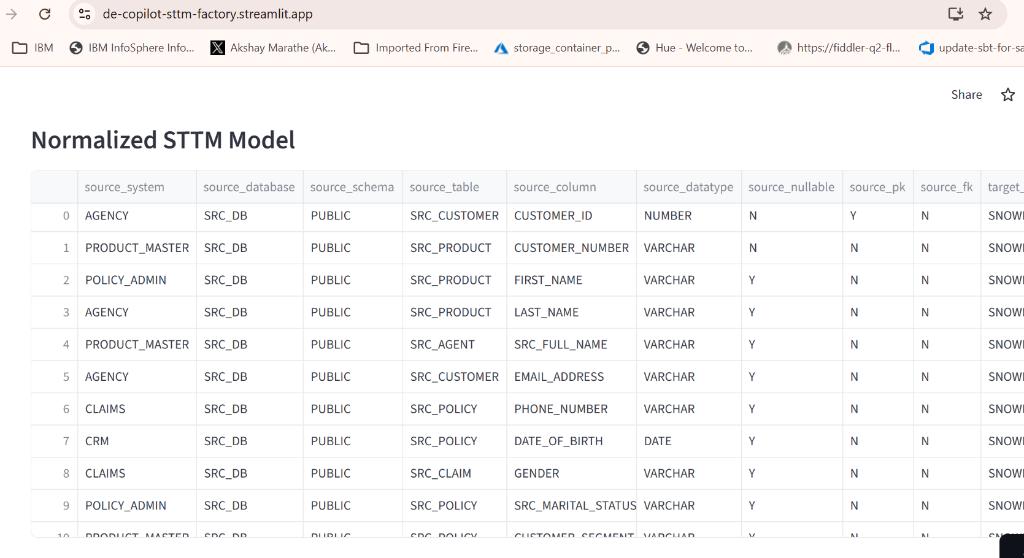
After normalization, the platform produces a structured view across all source systems - AGENCY, PRODUCT_MASTER, POLICY_ADMIN, CLAIMS, CRM - with source schema, source table, source column, data type, and nullability fully preserved. This normalized model drives all downstream artifact generation.
Generated Snowflake DDL
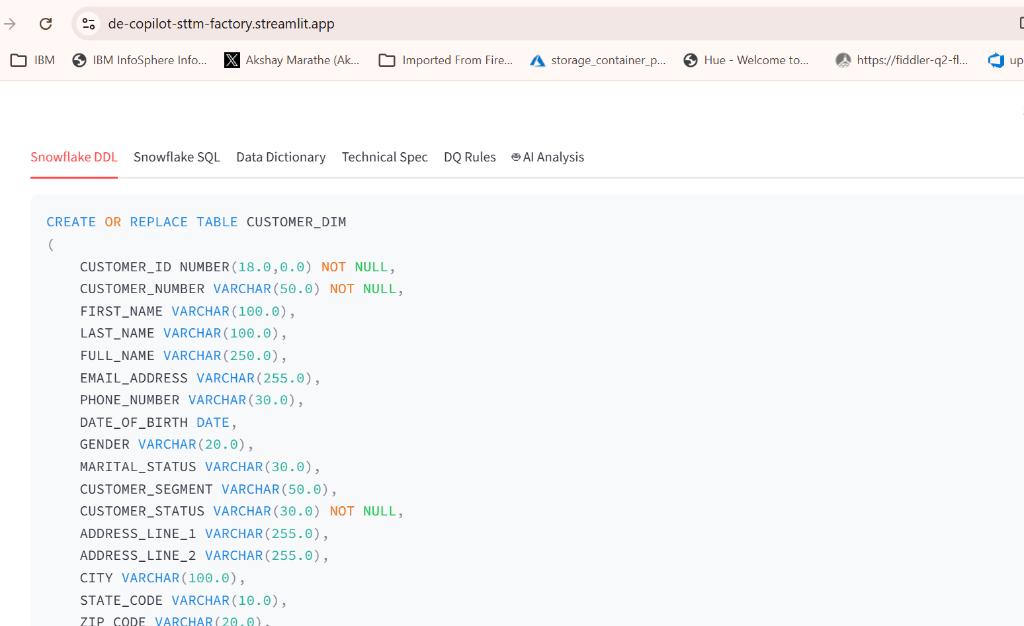
The artifact generation engine produced a complete CREATE OR REPLACE TABLE CUSTOMER_DIM statement with all column definitions - data types, lengths, and NOT NULL constraints - derived directly from the STTM metadata. No manual DDL writing required.
Generated Data Quality Rules
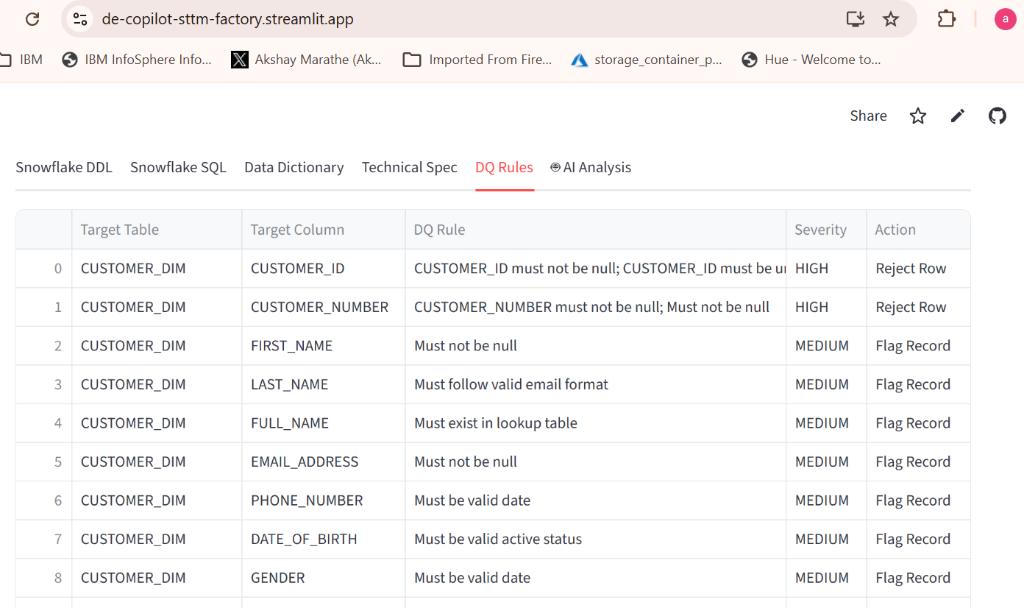
The DQ Rules artifact generated enforcement rules for every target column in CUSTOMER_DIM - including NOT NULL checks (HIGH severity, Reject Row), uniqueness constraints, email format validation, lookup existence checks, date validity, and active status checks (MEDIUM severity, Flag Record). All rules derived automatically from the STTM metadata.
Engineering Outputs Generated
The uploaded STTM was automatically transformed into multiple engineering deliverables.
Generated artifacts included:
- •Snowflake DDL
- •Snowflake SQL
- •Data Dictionary
- •Technical Specification
- •Data Quality Rules
- •AI Analysis
Rather than manually creating each artifact independently, DE Copilot generated them from a single metadata source.
The goal is not to replace data engineers.
The goal is to reduce repetitive documentation and artifact generation work so engineers can focus on architecture, data modeling, validation, and business requirements.
What Was Actually Being Tested
This experiment was designed to evaluate metadata understanding rather than data processing.
The STTM contained multiple categories of enterprise metadata including:
- •Source and target mappings
- •Datatype definitions
- •Nullability rules
- •Primary and foreign keys
- •Transformation logic
- •Lookup definitions
- •Data quality controls
- •SCD attributes
- •Data masking policies
- •Ownership metadata
- •Governance controls
The challenge was determining whether a generalized metadata model could interpret these structures consistently enough to generate reusable engineering artifacts.
The test successfully demonstrated that a canonical metadata model can act as an abstraction layer between diverse STTM formats and downstream artifact generation.
What This Means
The stress test validated the core hypothesis behind DE Copilot:
A metadata-driven engine can generalize across enterprise STTM structures without project-specific coding.The key architectural component enabling this capability is the Canonical Metadata Model.
By normalizing diverse STTM formats into a consistent internal representation, downstream artifact generation becomes independent of the original spreadsheet structure.
This approach allows engineering teams to reuse the same generation framework across projects rather than building custom accelerators for each implementation.
The result is a scalable foundation for metadata-driven engineering automation.
The Future of Metadata-Driven Engineering
Today DE Copilot generates six artifact types from a single STTM upload:
- •Snowflake DDL
- •Snowflake SQL
- •Data Dictionary
- •Technical Specifications
- •Data Quality Rules
- •AI Analysis
The architecture is metadata-driven, not platform-specific. Once the canonical metadata model is in place, the same normalized STTM can target any platform or framework without rebuilding the core engine.
Code Generation
- •PySpark
- •Spark SQL
- •Databricks Notebooks
- •Delta Live Tables (DLT)
- •dbt Models
- •Airflow DAGs
- •Azure Data Factory Pipelines
- •AWS Glue Jobs
- •Informatica Mappings
- •Talend Jobs
- •DataStage Jobs
- •Matillion Jobs
Database Targets
The business logic stays the same. Only the target template changes.
- •Snowflake
- •Oracle
- •SQL Server
- •PostgreSQL
- •MySQL
- •Teradata
- •BigQuery
- •Redshift
- •Synapse
Testing Automation
- •SIT Test Cases
- •UAT Test Cases
- •Positive Tests
- •Negative Tests
- •KPI Validation Scripts
- •Reconciliation Reports
- •Great Expectations Tests
- •Soda Checks
- •SQL Validation Scripts
Documentation Automation
- •BRD Drafts
- •Technical Design Documents
- •Runbooks
- •Deployment Guides
- •Operational Guides
- •Data Product Documentation
AI Knowledge Layer
Upload an STTM and ask:
- •Which fields are PII?
- •What source systems feed this data product?
- •Which transformations calculate a KPI?
- •What reports will be impacted by a column change?
- •What DQ rules exist?
The STTM becomes searchable, queryable, and lineage-aware.
Enterprise Platform Generation
Long-term vision: upload a single STTM and generate a complete data platform.
Upload STTM
      ↓
Generate Data Platform
      ├─ Database Objects
      ├─ Transformation Code
      ├─ CI/CD Pipelines
      ├─ Infrastructure Templates
      ├─ Monitoring Rules
      ├─ Data Quality Framework
      └─ Documentation
The long-term vision is not simply generating SQL. The vision is transforming enterprise metadata into complete engineering deliverables through a metadata-driven architecture.
Try The STTM Factory
Explore the DE Copilot STTM Factory and upload your own mapping document. The platform will automatically detect metadata structures, normalize mappings, generate Snowflake DDL and SQL, build a Data Dictionary, create Technical Specifications, generate Data Quality Rules, and produce AI-assisted Analysis.
Launch STTM FactoryFinal Thoughts
Building DE Copilot has reinforced a simple observation:
STTM files are not merely spreadsheets.
They are structured metadata describing how enterprise data products are built.
The challenge is not generating SQL. The challenge is understanding metadata consistently enough to automate engineering workflows across every platform, framework, and artifact type an enterprise needs.
This stress test represents an early validation of that approach.
The current output is Snowflake-focused. The long-term vision is platform-agnostic - where a single normalized STTM becomes the source of truth for every engineering artifact a project requires, from DDL to test cases to deployment pipelines.
That is the direction DE Copilot is being built toward.
Want to Understand the Architecture Behind DE Copilot?
Read: The Canonical Metadata Model: The Engine Behind DE Copilot
The stress test showed what DE Copilot generates. This article explains the engine that makes it possible - and why the same metadata can power unlimited outputs across any platform.
Continue Exploring DE Copilot
The stress test demonstrated that a metadata-driven engine can successfully interpret complex enterprise STTM structures and generate multiple engineering artifacts.
But how does it work internally?
Read next: ➡️ The Canonical Metadata Model: The Engine Behind DE CopilotThis article explains the architecture that enables DE Copilot to normalize diverse STTM formats into a single canonical representation, making downstream artifact generation independent of spreadsheet structure.
Ready to test it yourself?Upload a real STTM and see how DE Copilot generates engineering artifacts from a single metadata source.
➡️ Try DE CopilotContinue Reading
The Engine Behind DE Copilot: Why the Canonical Metadata Model Matters
Most people see DE Copilot as a code generation tool. The real engine sits in the middle - a metadata abstraction layer that transforms enterprise STTMs into unlimited engineering deliverables.
How Snowflake Cortex Helped Me Turn an STTM into a Governed Customer 360
A practical pattern for moving from source-to-target mappings and business definitions to a semantic Customer 360 model that business users can query safely.